
Introduction:
Buying laboratory chemicals in Bangladesh can be confusing and risky, especially for QC labs, pharmaceutical companies, universities, and research organizations. Many buyers struggle with questions like: Which brand is reliable? Which grade should I choose? Is this product original or fake? One wrong decision can lead to failed tests, repeated analysis, regulatory issues, and even safety hazards in the lab.
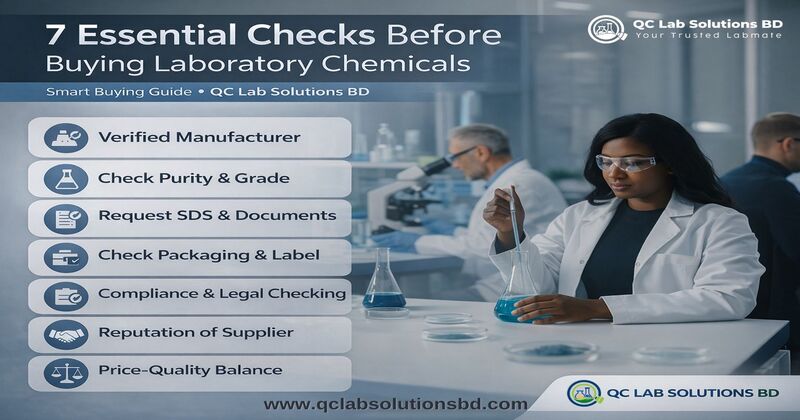
To help you avoid these problems, here is a practical checklist of 7 essential checks you should follow before buying laboratory chemicals in Bangladesh.
1. Verify the Brand and Manufacturer:
The first and most important step is to check who is actually making the product.
- Prefer well‑known international or reputable local brands that are already used in established QC or research labs.
- Always check the manufacturer name, country of origin, and official website on the label or catalog.
- Look for certifications or global presence (e.g., serving pharma, food, academic, or research sectors worldwide).
- Be careful with unknown brands or “only repack” bottles with no clear information about the original manufacturer.
A good brand does not just mean a higher price; it usually means better consistency, traceability, and reliability—which directly affects your test results.
2. Confirm the Chemical Grade (AR, HPLC, LR, etc.):
Choosing the right grade is critical for accurate and reproducible results. Different applications require different grades:
- AR (Analytical Reagent Grade): Suitable for most analytical and titration work.
- HPLC Grade: High purity, low UV-absorbing impurities; ideal for HPLC and sensitive analytical methods.
- GC Grade: Specially purified for Gas Chromatography.
- LR (Laboratory Reagent) / Technical Grade: OK for general lab use, cleaning, or non‑critical work, but not ideal for precise analysis.
- Pharmaceutical / USP / BP Grade: Suitable for pharma formulations and regulated applications.
Example:
If you are running HPLC analysis, using LR or Technical grade solvent can introduce background noise, ghost peaks, and poor sensitivity. For such applications, HPLC grade is essential.
Before buying, always ask yourself:
> “Is this chemical grade suitable for my method and regulatory requirements?”
3. Review the COA (Certificate of Analysis) and Specifications:
A genuine and high-quality laboratory chemical should always come with a COA (Certificate of Analysis). COA is your proof of quality.
On the COA, check for:
- Purity percentage (e.g., ≥99.5%) and limits of key impurities.
- Batch/Lot number – must match the bottle/label.
- Manufacturing and Expiry dates.
- Test methods or reference standards used (e.g., according to pharmacopeia or internal validated methods).
- Physical properties (appearance, density, etc.), where applicable.
Red flags to be careful about:
- No COA provided, even when requested.
- Very generic COA (no batch number, no clear test values).
- Photocopies with altered information or obvious editing.
Always keep COAs filed properly; they are vital during audits, investigations, or method troubleshooting.
4. Check Packaging, Labeling, and Batch Details:
Proper packaging and labeling are not just formalities; they are part of quality and safety.
On the label, you should find:
- Product name and chemical name (with formula and CAS number if possible).
- Grade (AR, HPLC, LR, etc.).
- Brand/manufacturer name and logo.
- Batch/Lot number.
- Manufacturing and expiry date or retest date.
- Net quantity/volume.
- Storage conditions (e.g., 2–8°C, protect from light, keep tightly closed).
- Hazard symbols and basic safety information.
Inspect the physical packaging:
- Check if the seal is intact and not tampered with.
- Avoid bottles with leakage, rusted caps, faded labels, or poor print quality.
- Be careful if the label looks like a cheap sticker or if key information is missing.
If packaging looks suspicious, it may indicate poor handling, repacking, or even counterfeit product.
5. Evaluate Storage and Transportation Conditions:
Many laboratory chemicals are sensitive to temperature, light, moisture, or air. If they are not stored or transported properly, quality can degrade before you even use them.
Important points to check:
- Ask your supplier:
- How do you store these chemicals (warehouse conditions)?
- How do you transport them, especially in summer or for long distances?
- For temperature-sensitive chemicals (e.g., enzymes, some standards, reagents):
- Check if cold chain or insulated packaging is used.
- For light-sensitive chemicals (e.g., some HPLC solvents, indicators):
- Dark bottles and proper protection from direct sunlight are necessary.
- For hygroscopic chemicals (absorbing moisture from air):
- Ensure tight caps, desiccators, and recommended storage conditions are followed.
If a chemical arrives too hot, leaked, or with crystal changes/color changes, it may already be compromised.
6. Check Regulatory Compliance and Documentation:
If you are working in pharmaceutical, food, agro, or regulated industries, documentation and compliance are as important as purity.
Important documents and aspects:
- SDS (Safety Data Sheet): Should be available for every chemical; provides detailed safety, handling, and emergency information.
- Compliance with ISO, GLP, GMP, or local regulatory guidelines:
- Your chemicals should be acceptable under your internal QA system and external regulators.
- Traceability:
- You should be able to trace each chemical back to a specific batch and manufacturer through labels and COAs.
During audits, inspectors often ask:
- “Where is the COA?”
- “Is this chemical suitable grade for this test?”
- “Can you show documentation for this batch?”
If your supplier cannot support you with proper documents, it can create serious problems later.
7. Assess Supplier Reliability, Support, and Availability:
Even the best brands will not help if your supplier is not reliable.
Key factors to consider:
- Reputation: Does the supplier regularly serve established labs, pharma companies, or universities?
- Authenticity: Are they authorized distributor/stockist of the brands they are selling?
- Stock and continuity: Can they provide consistent supply of the same brand and grade, especially for validated methods in QC?
- Technical support:
- Can they guide you in selecting the right brand and grade?
- Can they share COA, SDS, and product data quickly when needed?
- Are they responsive if there is an issue with a particular batch?
A good supplier is not just a seller; they act as a technical partner to your lab.
Common Mistakes to Avoid When Buying Lab Chemicals in Bangladesh
Even experienced labs often make these mistakes:
- Choosing only by price and ignoring brand, grade, or documentation.
- Using different brands or grades for the same validated test method without proper re‑validation.
- Ordering large quantities without checking expiry date, storage conditions, or actual consumption rate.
- Buying from random or unknown vendors just because they are cheap or “close to the lab.”
In the long run, these mistakes can cost much more in terms of failed batches, repeat tests, audit observations, and wasted time.
Conclusion:
Laboratory chemicals are not just ordinary items; for a QC or research lab, they are critical raw materials. The quality, grade, and reliability of the chemicals you buy directly affect your test results, compliance, and reputation.
By following these 7 essential checks—brand, grade, COA, packaging, storage, compliance, and supplier reliability—you can reduce risk, save time, and ensure more consistent results in your lab.
If your lab in Bangladesh needs help selecting the right brand, grade, or product for specific applications, you should work with a supplier that understands both quality standards and local challenges—and is ready to support you with proper documentation and technical guidance.
 QC Lab Solutions BD - 𝒴ℴ𝓊𝓇 𝓉𝓇𝓊𝓈𝓉ℯ𝒹 𝓁𝒶𝒷𝓂𝒶𝓉ℯ
Sed lacinia, urna non tincidunt mattis, tortor neque adipiscing diam, a cursus ipsum ante quis turpis. Nulla facilisi. Ut fringilla. Suspendisse potenti. Nunc feugiat mi a tellus consequat imperdiet. Vestibulum sapien. Proin quam. Etiam ultrices.
Quisque volutpat condimentum velit. Class aptent taciti sociosqu ad litora torquent per conubia nostra, per inceptos himenaeos. Nam nec ante.
Curabitur sit amet mauris. Morbi in dui quis est pulvinar ullamcorper. Nulla facilisi. Integer lacinia sollicitudin massa. Cras metus.
test